What Does Gas Hot Water System Installation Actually Cost in Sydney?
If you are planning a gas hot water system installation in Sydney, the total cost typically falls between $1,200 and $3,500 depending on the type of system, whether gas is already connected, and the complexity of the install. This guide breaks down every cost factor, explains what you are paying for, and tells you when gas is – and is not – the right choice for your Sydney home.
Gas Hot Water System Installation Cost Breakdown – Sydney 2026
Gas hot water installation costs in Sydney have held relatively steady over the past 12 months, though labour rates have risen with the broader trade market. Below is a complete cost breakdown for the most common installation scenarios.
| Installation Scenario | Unit Cost | Labour | Total (approx) |
|---|---|---|---|
| Replace gas storage with gas storage | $800 – $1,400 | $400 – $600 | $1,200 – $2,000 |
| Install gas continuous flow (existing gas) | $900 – $1,800 | $500 – $700 | $1,400 – $2,500 |
| Switch from electric to gas (existing gas line) | $900 – $1,800 | $700 – $1,200 | $1,800 – $3,200 |
| New gas connection + system install | $900 – $1,800 | $1,500 – $3,000 | $2,500 – $5,000+ |
| LPG system (no natural gas available) | $900 – $1,800 | $500 – $800 | $1,500 – $2,600 |
These figures are based on Sydney metro rates for a licensed gas plumber. Prices in the Central Coast and Newcastle are broadly similar, though travel charges may apply for remote sites. All gas work in NSW requires a licensed gas fitter – budget quotes that seem unusually low often come without the required compliance certificate.
What affects the final price?
The four biggest variables in any gas hot water installation job are:
- Gas pipe routing: If the new unit goes in the same location as the old one, pipe work is minimal. Moving the unit to a different wall or area adds pipe run cost.
- System size: A 135L gas storage unit for a couple costs less than a 360L system for a family of six. Continuous flow sizing depends on the number of simultaneous outlets your household uses.
- Access difficulty: Roof space, narrow side passages, or confined areas take longer to work in – this increases labour time.
- Compliance requirements: NSW requires a Certificate of Compliance (gas fitting work) for all new gas installations. This is included in most professional quotes but worth confirming.
Gas Continuous Flow vs Storage: Which Should You Install?
Both system types run on natural gas or LPG, but they work differently and suit different households.
Gas storage hot water
A gas storage system heats a tank of water and keeps it at temperature throughout the day and night. Models range from 90L (suits 1-2 people) to 360L (suits 5-6 people). Gas storage systems are straightforward to install, widely available, and reliable. The main drawbacks: standby heat loss (you pay to keep water hot even when not in use), and the risk of running out of hot water during peak demand.
Gas continuous flow hot water
Continuous flow (also called instantaneous or tankless) systems heat water only when a tap is opened. There is no tank, no standby heat loss, and no risk of running out. They are more fuel-efficient than storage systems and popular with medium to large households in Sydney. Installation requires a minimum gas pressure and flow rate assessment – On Time Tradie’s plumbers carry the tools to test this on the spot.
For a full comparison of gas, electric, solar, and heat pump systems, see our Complete Hot Water System Replacement Guide for Sydney Homes 2026.
Which is more cost-effective?
For a household of 3 to 5 people in Sydney, a 5-star gas continuous flow system typically offers the best balance of installation cost and running efficiency. Smaller households (1-2 people) can often do well with a compact gas storage unit. If gas pressure at your property is marginal, storage is the safer installation choice.
What If You Don’t Have Gas Connected?
If your home is all-electric and you want to install a gas hot water system, there are two paths: connect to the natural gas network, or install an LPG system with bottled gas.
Connecting to natural gas (Jemena network)
Natural gas is available across most of Sydney’s established suburbs. The process to connect involves:
- Your plumber confirms the gas main is present in your street
- An application is made to Jemena (Sydney’s gas distributor) for a new meter connection
- Jemena installs the meter (typically 3-6 weeks lead time)
- Your licensed gas plumber runs internal pipework and installs the hot water system
- A compliance certificate is issued
The Jemena connection itself (meter installation) is charged by the network – currently around $350 to $800 depending on service type. This is separate from your plumber’s labour for internal work. Energy Australia provides a useful overview of Sydney gas plans and connection costs that you can use to compare retailer rates once connected.
LPG as an alternative
If natural gas is not available in your street or the wait time is too long, LPG (bottled gas) can power the same hot water systems. Most Rinnai, Rheem, and Dux continuous flow units are available in LPG configurations. Running costs are higher – typically $100 to $200 per year more than natural gas. LPG requires outdoor space for the gas bottle, and regular bottle swaps or scheduled refills from your gas supplier.
If you are unsure which option suits your home, see our Gas Plumbing Safety guide for Sydney homeowners.
What Happens During a Gas Hot Water System Installation?
Understanding the installation process helps you know what to expect on the day.
Pre-installation assessment
A good gas plumber will assess gas pressure and flow at your meter before selecting your system size. This step matters – undersizing a continuous flow unit leads to temperature drops when multiple taps run simultaneously. On Time Tradie includes this assessment at no extra charge on all hot water installs.
On the day
For a straightforward replacement (same location, gas already connected), expect the job to take 2 to 4 hours. This covers disconnection of the old unit, installation of the new unit, gas pipe connection, pressure testing, commissioning, and a basic demonstration of the temperature controls. The plumber will also confirm your anode rod replacement schedule if it is a storage system.
After installation
You will receive a Certificate of Compliance for gas fitting work. Keep this for your records – it is required for insurance purposes and will be needed if you ever sell the property. In NSW, this certificate must be issued by a licensed gas fitter for any new gas installation or alteration.
Gas Hot Water Brands Available in Sydney
The Sydney market is dominated by three major brands for gas hot water systems. All are readily available with local service agents and spare parts.
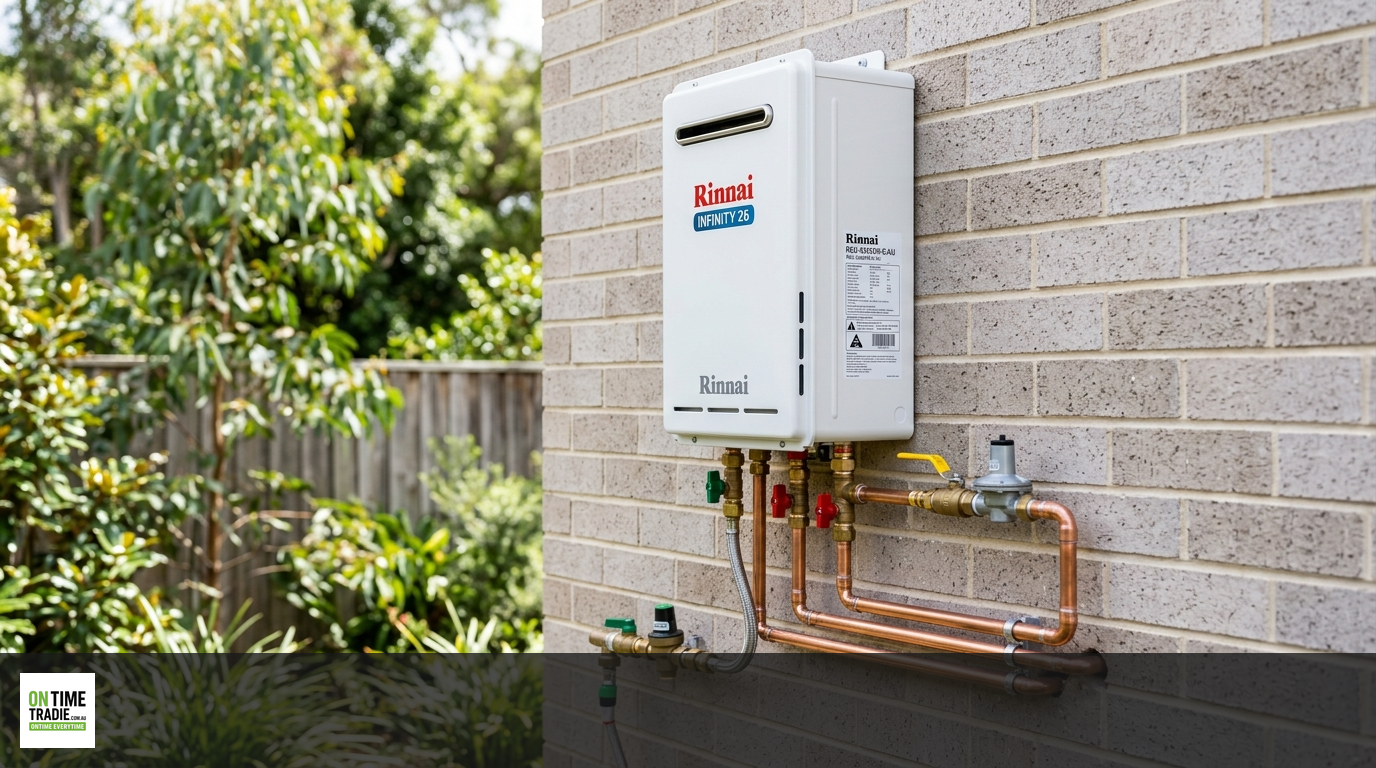
- Rinnai: Market leader for continuous flow. The Infinity series (16, 20, 26, and 32 litre per minute models) suits most Sydney households. 12-year heat exchanger warranty on select models.
- Rheem: Strong contender for both storage and continuous flow. The Pronto continuous flow range and Metro storage range are well-priced and well-supported.
- Dux: Good mid-range option for storage systems. Often slightly lower unit cost than Rinnai or Rheem. Wide parts availability through plumbing trade suppliers.
On Time Tradie’s plumbers carry Rinnai and Rheem units on the van for most standard residential sizes, enabling same-day installation in many cases.
When Gas Is Not the Right Choice
Gas is not automatically the best solution for every Sydney home. Here are four situations where a different system makes more practical sense:
- You have a large solar PV system: A heat pump hot water system running on daytime solar can cut annual hot water costs to under $100. The heat pump itself costs more upfront, but rebates (Small-scale Technology Certificates) substantially reduce the purchase price.
- Your property has no gas and the wait is too long: If your current system has failed and you need hot water today, an electric system can be installed the same day without any network dependency.
- You are in a new-build or strata: Many new apartment buildings in NSW are being designed without gas. Installing gas in a strata building requires body corporate approval and may not be permitted at all.
- Long-term investment perspective: NSW is following Victoria’s direction in phasing gas out of new residential buildings. If you plan to stay in the property 15 to 20 years, a heat pump with solar may be a better long-term position.
Not sure which system to choose? Read our Emergency Plumbing Handbook if your current system has failed and you need urgent guidance, or our Tradie vs DIY guide to understand what you can and cannot do yourself when it comes to hot water work.
Get a Straight Quote for Gas Hot Water Installation in Sydney
On Time Tradie’s licensed gas plumbers service Sydney, Central Coast, and Newcastle. We’ll assess your gas supply, recommend the right system, and give you a clear upfront price. Ontime Everytime.
Frequently Asked Questions
How much does it cost to install a gas hot water system in Sydney?
Most Sydney homeowners pay between $1,200 and $3,500 for a gas hot water system installation, depending on whether gas is already connected and the type of system chosen. Replacing a like-for-like gas storage system is at the lower end. Switching from electric to gas with pipe work involved sits in the $1,800 to $3,200 range. Adding a brand-new gas connection pushes the total above $3,500 in most cases.
How long does installation take?
A standard like-for-like gas replacement typically takes 2 to 4 hours. If new pipe work is required or the unit is moving to a different location, allow 4 to 6 hours. A full new gas connection (including Jemena meter installation) can take 3 to 6 weeks to coordinate, so plan ahead if your current system is ageing.
Do I need a certificate after a gas hot water installation?
Yes. In NSW, any gas fitting work – including hot water system installation – must be carried out by a licensed gas fitter who provides a Certificate of Compliance upon completion. This certificate is required for insurance purposes and for property sales. Always ask your plumber for this document at the end of the job.
Is a gas continuous flow system worth the extra cost?
For most Sydney families of 3 or more, yes. Continuous flow systems eliminate standby heat loss, never run out of hot water, and typically save $50 to $150 per year compared to a gas storage system. The higher upfront cost is generally recovered within 3 to 5 years through running cost savings.
Can On Time Tradie install gas hot water same day in Sydney?
In most cases, yes. Our team carries the most common Rinnai and Rheem units on the van and can complete a same-day installation when gas is already connected at your property and the call comes in before noon. For emergency replacements (failed system), call us directly and we’ll prioritise your job.
What size gas hot water system do I need?
For gas storage: a 135L system suits 1-2 people, a 170-250L system suits 3-4 people, and a 315-360L system suits 5-6 people. For continuous flow: a 20 litre-per-minute unit suits most 3-4 person households with 2 bathrooms. Your plumber will calculate the right size based on your peak demand scenario.
Are there rebates for gas hot water installation in NSW?
Gas systems do not qualify for federal STC (Small-scale Technology Certificate) rebates, which are reserved for solar and heat pump systems. However, under the NSW Energy Savings Scheme, replacing an old inefficient electric storage system with a high-efficiency gas unit may qualify for an energy savings certificate rebate. Your licensed plumber can advise on current eligibility at the time of your installation.