
Your morning starts with an icy shower. The hot water system that reliably served your Sydney home for 12 years has finally given up—right when you need it most. Now you face a maze of choices: gas or electric? Traditional storage or instantaneous? What about solar or heat pump systems everyone talks about? And how much will it actually cost in 2026?
For Sydney, Central Coast, and Newcastle homeowners, hot water system replacement represents one of the most significant home maintenance investments—typically $1,500 to $7,000 depending on your choice. With March 2026 marking the transition from summer into autumn and winter, hot water demand is about to surge by 40%. Systems that limped through summer will face increasing strain in coming months, making now the perfect time to plan your replacement before emergency failures force rushed decisions.
This comprehensive guide from OnTime Tradie’s licensed plumbers delivers everything you need to make an informed hot water system replacement decision. We compare all four major system types, break down 2026 Sydney pricing including installation, explore NSW government rebates up to $1,000, reveal which systems suit different household sizes and climates, and provide expert recommendations based on 20+ years serving Sydney homes. Whether you are replacing a failed system or proactively upgrading to energy-efficient technology, this guide ensures you choose the right hot water solution for your home and budget.
When Do You Need Hot Water System Replacement? Critical Signs Sydney Homeowners Should Not Ignore
Most hot water systems do not fail catastrophically overnight—they provide warning signs weeks or months before complete failure. Recognizing these signals helps you plan replacement during business hours rather than facing emergency callouts at premium rates.
Hot water systems have finite lifespans determined by technology type, water quality, maintenance history, and usage patterns. Here is what Sydney homeowners need to know:
Average Hot Water System Lifespan by Type
- Electric Storage (Tank): 8-12 years – Most common in Sydney homes, sacrificial anode rod determines lifespan
- Gas Storage (Tank): 10-15 years – Longer lifespan than electric, pilot light and burner require periodic maintenance
- Gas Continuous Flow (Instantaneous): 15-20 years – No storage tank means longer operational life, heat exchanger is weak point
- Heat Pump: 10-15 years – Compressor lifespan similar to air conditioner, tank subject to same issues as electric
- Solar Hot Water: 15-25 years – Panels last 20-25 years, storage tanks 10-15 years, pumps and controllers 8-12 years
Warning Signs Requiring Immediate Professional Assessment
1. Water Temperature Inconsistency
Lukewarm showers, temperature fluctuations, or inability to reach desired heat indicate failing heating elements (electric), pilot light issues (gas), or sediment buildup reducing efficiency.
2. Visible Rust or Corrosion
Rust-colored water, corrosion on tank exterior, or rust around connections signal internal tank deterioration. Once rusting starts internally, tank failure is imminent.
3. Leaking Tank or Connections
Any water pooling around your hot water system requires immediate inspection. Small leaks worsen rapidly and can cause significant property damage.
4. Strange Noises
Popping, rumbling, or banging sounds indicate sediment buildup heating and expanding at tank bottom. This accelerates tank wear and reduces efficiency by 20-30%.
5. Reduced Hot Water Capacity
Running out of hot water faster than previously suggests failing heating elements, sediment reducing tank capacity, or undersized system for current household needs.
6. Age Over 10 Years
Even without obvious symptoms, systems exceeding 10 years approach failure risk zone. Proactive replacement avoids emergency scenarios.
7. Rising Energy Bills
Gradual efficiency decline means your system works harder to deliver same results. New energy-efficient systems cut operating costs by 30-60%.
8. Discolored or Smelly Water
Brown, yellow, or metallic-smelling hot water indicates corroded anode rod or tank interior. Bacteria can colonize failing tanks, creating sulfur smell.
9. Pressure Relief Valve Leaking
This safety valve continuously dripping or discharging signals dangerous pressure issues requiring immediate professional attention.
CRITICAL TIMING CONSIDERATION: Emergency after-hours hot water system replacement costs 50-100% more than scheduled business hours installation. A $2,500 planned replacement becomes $3,750-$5,000 as a Sunday emergency. When you notice warning signs, schedule assessment immediately rather than waiting for catastrophic failure.
Complete Hot Water System Types Comparison: Gas vs Electric vs Solar vs Heat Pump
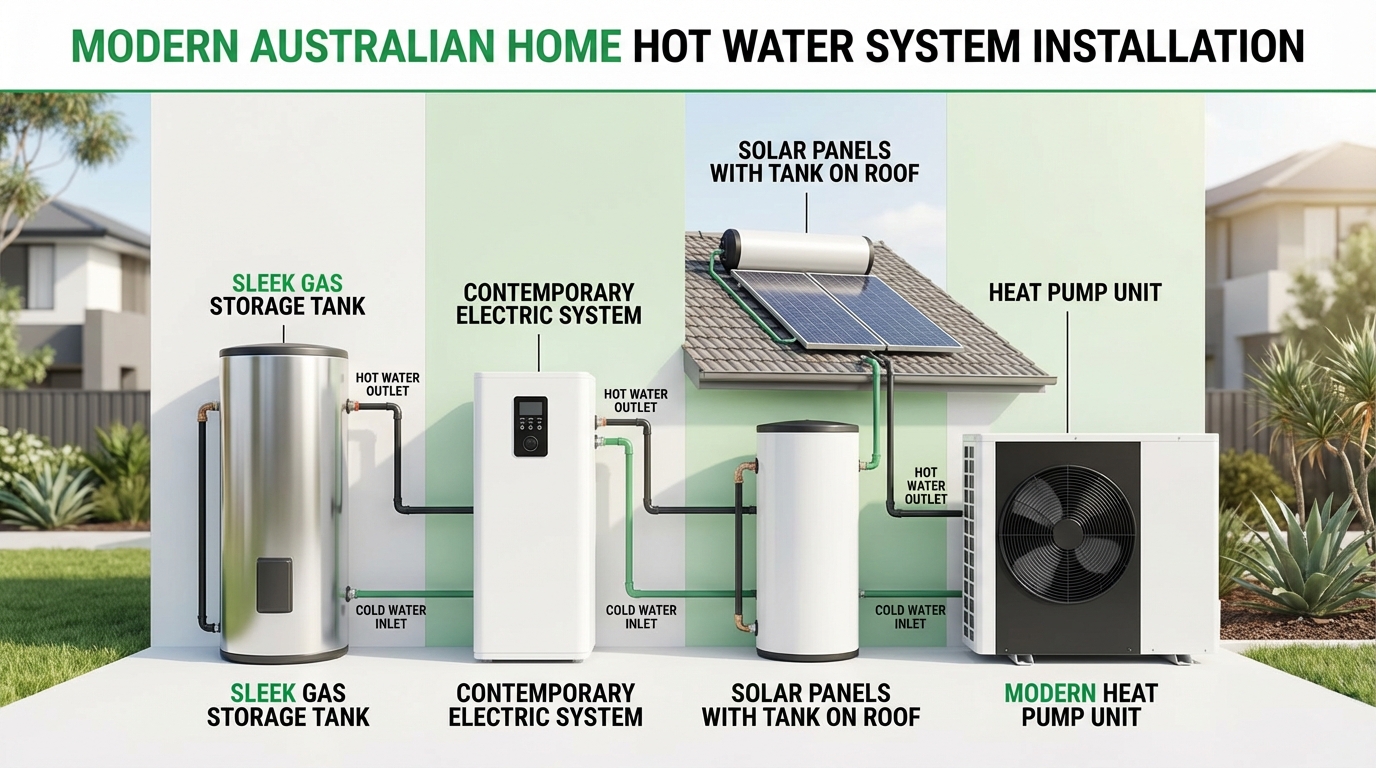
Sydney homeowners face four primary hot water system categories, each with distinct advantages, limitations, and cost profiles. Understanding these technologies helps match the right system to your household needs, property characteristics, and budget.
1. Gas Storage Hot Water Systems
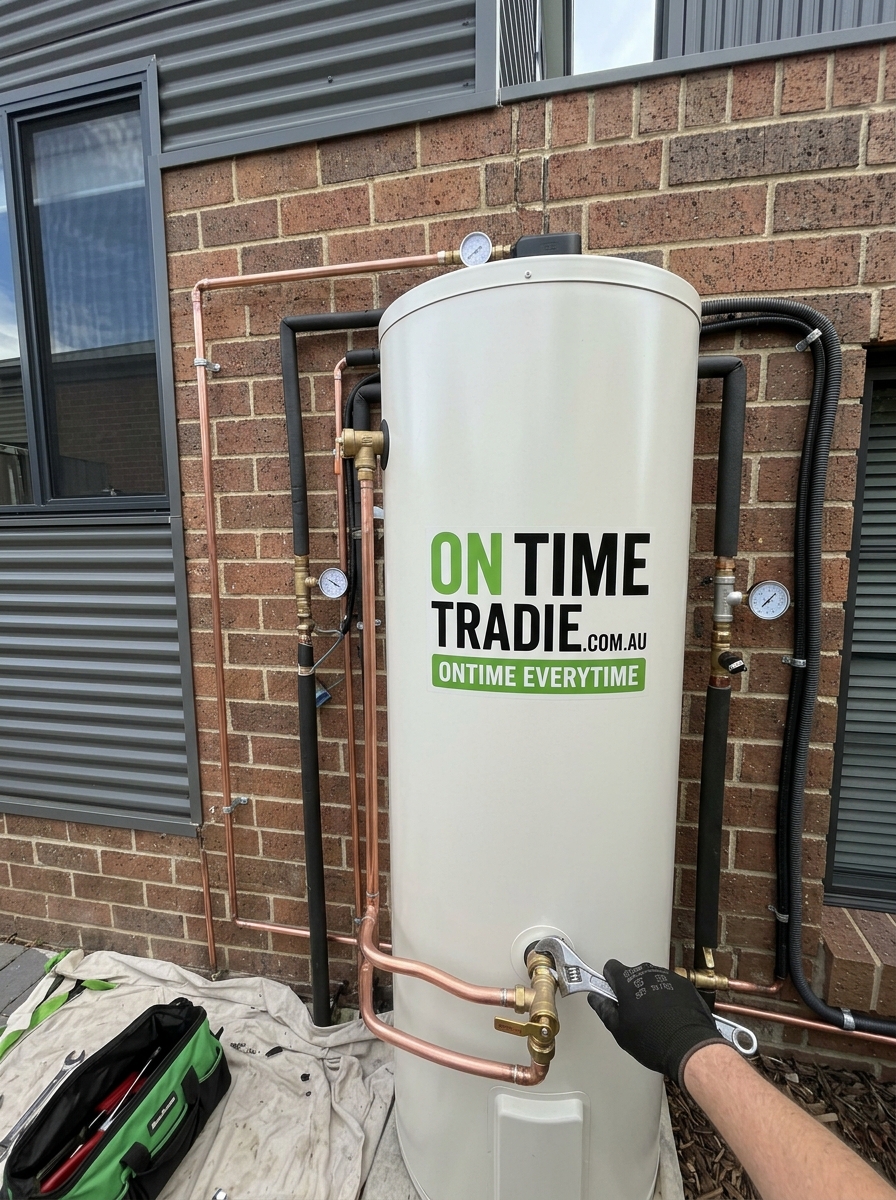
Gas storage systems heat water using natural gas or LPG and store it in an insulated tank. These remain popular across Sydney for their fast recovery rates and lower running costs compared to electric storage systems.
How They Work: A gas burner at the tank base heats water continuously or when temperature drops below setpoint. Pilot light (older models) or electronic ignition (newer models) initiates burner when needed.
Best For:
- Households with existing gas connection
- Families needing rapid hot water recovery during peak usage
- Properties in areas with higher electricity costs
- Homes without suitable solar panel orientation
Key Advantages:
- Lower operating costs than electric storage (approximately 50% cheaper to run)
- Faster heating recovery time during heavy usage
- Works during electricity blackouts (critical for Sydney storm season)
- Well-suited to Sydney climate year-round
Disadvantages:
- Higher upfront cost ($1,800-$3,500 installed)
- Requires gas connection or LPG bottle delivery
- Pilot light models waste gas continuously
- Tank insulation determines standing heat loss
- Lifespan typically 10-15 years
2026 Sydney Installation Cost: $1,800-$3,500
- 135L system: $1,800-$2,400 (suitable for 2-3 people)
- 170L system: $2,200-$2,900 (suitable for 3-4 people)
- 250L+ system: $2,600-$3,500 (suitable for 5+ people)
Popular brands: Rinnai, Rheem, Dux, AquaMAX
Annual Running Costs (Sydney): $450-$650 for typical 4-person household
2. Electric Storage Hot Water Systems
Electric storage hot water systems remain the most common type in Sydney homes due to lowest upfront cost and simple installation. However, they are also the most expensive to operate long-term.
How They Work: One or more heating elements inside the tank heat water, typically on off-peak electricity tariffs overnight. Insulation maintains water temperature throughout the day.
Best For:
- Homes without gas connection
- Budget-conscious initial installation
- Properties with solar panels offsetting electricity costs
- Replacement where existing electric infrastructure in place
Key Advantages:
- Lowest upfront installation cost ($900-$2,200)
- Simple, reliable technology
- No gas connection required
- Compatible with off-peak electricity tariffs
- Works efficiently with rooftop solar systems
Disadvantages:
- Highest ongoing running costs (approximately $850-$1,200 annually)
- Slowest recovery time during heavy usage
- Does not work during electricity blackouts
- Less energy-efficient than heat pump or solar alternatives
- NSW government actively discouraging electric storage replacements
- May not be compliant in new homes or major renovations
2026 Sydney Installation Cost: $900-$2,200
- 125L system: $900-$1,300 (suitable for 1-2 people)
- 250L system: $1,200-$1,700 (suitable for 3-4 people)
- 315L+ system: $1,500-$2,200 (suitable for 5+ people)
Popular brands: Rheem, Dux, Vulcan, AquaMAX
Annual Running Costs (Sydney): $850-$1,200 for typical 4-person household
IMPORTANT 2026 UPDATE: NSW is phasing out incentives for electric storage systems, making heat pump alternatives increasingly attractive from both cost and environmental perspectives.
3. Heat Pump Hot Water Systems (Highly Recommended 2026)
Heat pump hot water systems represent the most significant technological advancement in residential water heating. Operating like reverse air conditioners, they extract heat from surrounding air to heat water—delivering 3-4 times more energy than they consume.
How They Work: A compressor and refrigerant cycle extracts ambient heat from air and transfers it to water via a heat exchanger. A backup electric element provides supplementary heating during extreme cold or high demand.
Best For:
- Energy-conscious homeowners seeking long-term savings
- Properties with solar panels maximizing self-consumption
- Households eligible for NSW government rebates
- Locations with adequate outdoor space for unit placement
- Homes replacing aging electric or gas systems
Key Advantages:
- 60-75% lower running costs than electric storage systems
- Eligible for NSW government rebates up to $1,000 in 2026
- Environmentally friendly (significantly lower carbon emissions)
- Works efficiently in Sydney moderate climate year-round
- Can provide minor cooling effect to outdoor installation area
- Increasingly required for new homes and major renovations
Disadvantages:
- Higher upfront cost ($3,500-$6,000 installed)
- Requires outdoor space for compressor unit placement
- Can be noisy (similar to air conditioner outdoor unit)
- Efficiency decreases in very cold weather (rarely an issue in Sydney)
- More complex technology requires specialist technicians
- Installation restrictions in some strata/heritage properties
2026 Sydney Installation Cost: $3,500-$6,000 (before rebates)
- After NSW Government Rebate: $2,500-$5,000
- 200L system: $3,500-$4,500 (suitable for 2-3 people)
- 250L system: $4,000-$5,000 (suitable for 3-4 people)
- 315L+ system: $4,500-$6,000 (suitable for 5+ people)
Popular brands: Sanden, Reclaim Energy, iStore, Stiebel Eltron, Solahart
Annual Running Costs (Sydney): $250-$400 for typical 4-person household
2026 ROI ANALYSIS: Despite higher upfront cost, heat pumps save $450-$800 annually compared to electric storage. With rebates, payback period is typically 3-5 years, then pure savings for remaining 10+ year lifespan.
4. Solar Hot Water Systems
Solar hot water systems use roof-mounted solar collectors to heat water naturally using Sydney abundant sunshine. While popular in the 2000s-2010s, heat pumps now often deliver better value. However, solar still suits specific scenarios.
How They Work: Solar panels (different from electricity-generating photovoltaic panels) contain fluid that heats in sunlight. This heat transfers to water in storage tank via heat exchanger. Gas or electric backup ensures hot water during cloudy periods.
Best For:
- Properties with optimal north-facing roof space
- Households wanting maximum renewable energy independence
- Locations where heat pump noise is problematic
- Properties with heritage or aesthetic roof considerations
- Homes in sunny, coastal Sydney suburbs
Key Advantages:
- Free energy from sunlight after installation
- Lowest environmental impact
- Long panel lifespan (20-25 years)
- Minimal ongoing maintenance required
- Eligible for small-scale technology certificates (STCs)
- Silent operation (no compressor noise)
Disadvantages:
- Highest upfront cost ($4,500-$8,000 installed)
- Requires significant suitable roof space
- Dependent on weather (backup heating adds costs)
- Complex installation with roof penetrations
- Heavy roof-mounted tanks can cause structural concerns
- Performance varies significantly by orientation and shading
2026 Sydney Installation Cost: $4,500-$8,000
- After STC rebates: $3,500-$6,500
- 200L system: $4,500-$5,500 (suitable for 2-3 people)
- 300L system: $5,500-$7,000 (suitable for 3-4 people)
- 400L+ system: $6,500-$8,000 (suitable for 5+ people)
Popular brands: Solahart, Rheem, Edwards, Apricus, Rinnai
Annual Running Costs (Sydney): $150-$350 for typical 4-person household (primarily backup heating)
MODERN ALTERNATIVE: Many Sydney homes now choose rooftop photovoltaic solar panels + heat pump hot water system instead of solar hot water. This combination provides both electricity generation AND efficient hot water heating with better payback periods.
5. Gas Continuous Flow (Instantaneous) Systems
Gas continuous flow systems heat water on-demand without storage tanks, providing endless hot water. Popular for renovations and modern homes, particularly where space is premium.
How They Work: Cold water flows through a heat exchanger when hot tap is opened. Gas burner ignites automatically, instantly heating water to desired temperature as it passes through.
Best For:
- Space-constrained properties
- Households with highly variable hot water needs
- Modern renovations prioritizing aesthetics
- Properties with high-capacity gas supply
- Families frustrated by running out of hot water
Key Advantages:
- Unlimited hot water (never runs out)
- Compact wall-mounted design saves space
- Only heats water when needed (no standing heat loss)
- Longest lifespan (15-20 years)
- Lower running costs than electric storage
- Can supply multiple simultaneous outlets (with appropriate sizing)
Disadvantages:
- Higher upfront cost ($1,800-$4,500 installed)
- Requires adequate gas supply pressure
- Temperature can fluctuate with varying flow rates
- Cold water sandwich effect during intermittent use
- May require gas meter upgrade for larger units
- Professional sizing critical to performance
2026 Sydney Installation Cost: $1,800-$4,500
- 16L/min unit: $1,800-$2,800 (suitable for 1-2 simultaneous outlets)
- 20L/min unit: $2,400-$3,500 (suitable for 2-3 simultaneous outlets)
- 26L/min+ unit: $3,200-$4,500 (suitable for 3+ simultaneous outlets)
Popular brands: Rinnai Infinity, Rheem, Bosch, Eternal
Annual Running Costs (Sydney): $400-$600 for typical 4-person household
SIZING IS CRITICAL: Undersized instantaneous systems deliver disappointing performance. Professional assessment of simultaneous outlet usage and required flow rates ensures satisfaction.
Hot Water System Replacement Cost Sydney 2026: Complete Breakdown
Understanding the true cost of hot water system replacement requires looking beyond equipment price to include installation, disposal, permits, and potential additional work. Here is the complete financial picture for Sydney homeowners in 2026.
Complete Cost Components
- Hot Water System Unit: $600-$5,000 – Brand, capacity, technology type determines equipment cost
- Professional Installation: $400-$1,200 – Licensed plumber labor, typically 3-6 hours depending on complexity
- Old System Removal & Disposal: $150-$350 – Disconnection, safe disposal, compliance with environmental regulations
- Additional Plumbing Work: $200-$800 – Pipe modifications, valve upgrades, expansion tank installation (if required)
- Electrical Work: $200-$600 – Dedicated circuit, switchboard upgrades, safety switch installation (heat pumps require additional electrical)
- Gas Work: $150-$500 – Gas line modifications, new connections, pressure testing (gas systems only)
- Compliance & Permits: $100-$250 – Council notification, compliance certificates, inspection fees
- Structural Work: $0-$1,500 – Concrete pad for outdoor units, wall mounting brackets, roof penetrations (case-dependent)
NSW Government Rebates & Incentives 2026
Take advantage of these NSW government programs to reduce your hot water system replacement cost:
Heat Pump Hot Water Rebates (Energy Savings Scheme):
- Replacement of electric storage with heat pump: $405-$675 typical discount
- Replacement of gas storage with heat pump: $220-$330 typical discount
- Discounts applied at point of sale through accredited providers
- No income limits or eligibility restrictions for standard homes
- Actual discount varies by zone, system size, and displaced technology
Small-Scale Technology Certificates (STCs):
- Solar hot water systems eligible for STC rebates
- Typically $600-$1,500 off purchase price depending on system
- Assigned at point of sale, reducing upfront cost
- Heat pump systems also eligible for STCs
- Certificate value varies by location and installation date
How to Claim: Work with accredited installers (like OnTime Tradie) who process rebates directly. Rebates are assigned at installation, reducing your out-of-pocket costs immediately rather than requiring post-installation claims.
IMPORTANT: Rebate and incentive amounts change periodically. Confirm current values with your licensed plumber during quotation.
Total Investment Summary 2026
After rebates, here is what Sydney homeowners typically invest for complete hot water system replacement:
Budget Option (Electric Storage 250L): $1,200-$1,700 installed
- Lowest upfront cost
- Highest long-term running costs
- Best for: Short-term occupancy, budget constraints
Mid-Range Option (Gas Storage 170L): $2,200-$2,900 installed
- Balanced upfront and running costs
- Requires gas connection
- Best for: Gas-connected homes, moderate budgets
Recommended Option (Heat Pump 250L): $2,500-$5,000 after rebates
- Higher upfront investment
- 60-75% lower running costs than electric
- Best for: Long-term value, environmental concerns
Premium Option (Solar 300L): $3,500-$6,500 after STCs
- Highest upfront investment
- Lowest ongoing costs
- Best for: Maximum renewable energy, suitable roof space
Space-Saving Option (Gas Instantaneous 20L/min): $2,400-$3,500 installed
- Endless hot water supply
- Compact installation
- Best for: Space-constrained properties, gas-connected homes
How to Size Your Hot Water System: Sydney Household Guide
Correct sizing ensures consistent hot water availability without overpaying for unnecessary capacity. Undersized systems leave you with cold showers; oversized systems waste energy and money. Here is how to match capacity to your household needs.
Storage System Sizing Guide
1-2 People:
- Electric: 125-160L
- Gas: 135-170L
- Heat Pump: 200-250L (larger than electric due to slower heating)
- Solar: 200-250L
2-3 People:
- Electric: 160-250L
- Gas: 135-170L
- Heat Pump: 250-270L
- Solar: 250-300L
3-4 People:
- Electric: 250-315L
- Gas: 170-250L
- Heat Pump: 250-315L
- Solar: 300-360L
4-5 People:
- Electric: 315-400L
- Gas: 250-315L
- Heat Pump: 315-400L
- Solar: 360-400L
5+ People:
- Electric: 400L+
- Gas: 315L+ or instantaneous
- Heat Pump: 400L+
- Solar: 400L+ or dual system
Sizing Factors Beyond Household Size:
- Bathtub usage (baths consume 80-120L per fill)
- Multiple bathrooms and simultaneous usage patterns
- Washing machine hot water connection
- Dishwasher usage frequency
- Shower duration habits
- Peak usage timing (all showers within 1 hour vs. spread throughout day)
Instantaneous (Continuous Flow) System Sizing
Instantaneous systems are sized by flow rate (liters per minute) rather than storage capacity. Calculate your needs based on simultaneous outlet usage:
Flow Rate Requirements:
- Single shower: 8-10 L/min
- Large rainfall showerhead: 12-15 L/min
- Bath filling: 15-20 L/min
- Kitchen tap: 6-8 L/min
- Bathroom basin: 3-4 L/min
- Washing machine: 6-8 L/min
Example Scenarios:
- 1 shower running: 16L/min unit sufficient
- 1 shower + 1 tap: 20L/min unit recommended
- 2 showers simultaneously: 24-26L/min unit required
- 2 showers + kitchen tap: 26L/min+ unit required
PROFESSIONAL TIP: Size instantaneous units for your realistic maximum simultaneous usage scenario, not theoretical maximum. Oversizing wastes money without benefit; undersizing causes frustrating temperature fluctuations.
What to Expect During Professional Hot Water System Installation
Understanding the installation process helps Sydney homeowners prepare their property and schedule appropriately. Here is what happens when OnTime Tradie installs your new hot water system.
Installation Timeline & Process
Day 1 – Pre-Installation (Before Scheduled Date):
- Licensed plumber conducts site assessment
- Confirms system selection suits property
- Identifies any additional work required
- Provides detailed written quote
- Confirms installation appointment
Installation Day – Morning:
- Professional plumber arrives with new system and equipment
- Explains installation process and timeline
- Shuts off water and gas/electricity to existing system
- Safely disconnects and drains old hot water system
- Removes old unit and disposes according to regulations
Installation Day – Midday:
- Prepares installation location (concrete pad if required for outdoor units)
- Installs new hot water system with proper mounting
- Connects water supply with new valves and pressure relief
- Completes gas or electrical connections (depending on system type)
- For heat pumps: installs compressor unit and refrigerant connections
- For solar: mounts collectors and connects closed-loop system
Installation Day – Afternoon:
- Tests all connections for leaks
- Fills system and commissions
- Tests hot water delivery at all outlets
- Explains operation and maintenance to homeowner
- Provides compliance certificates
- Cleans work area thoroughly
Total Installation Time:
- Electric storage replacement: 2-4 hours
- Gas storage replacement: 3-5 hours
- Heat pump installation: 4-7 hours (includes outdoor unit)
- Solar installation: 6-10 hours (includes roof work)
- Instantaneous gas installation: 3-6 hours
Most installations complete in single day. Complex installations requiring additional plumbing, electrical, or structural work may extend to 2 days.
Homeowner Preparation Checklist
- Clear access pathway to existing hot water system
- Clear installation area of stored items, garden furniture, plants
- Ensure pets are secured away from work area
- Notify household members of water shutoff (typically 4-8 hours)
- For outdoor installations: unlock gates, provide access to property sides
- For heat pumps: identify preferred outdoor compressor location
- Have previous bills available to discuss usage patterns
- Arrange to be home for handover and explanation
- Understand systems operation before plumber departs
Choosing the Right Sydney Plumber for Hot Water System Installation
Hot water system installation requires licensed plumbing, electrical, and gas expertise depending on system type. Choosing qualified professionals ensures safe, compliant installation that lasts.
Essential Credentials & Qualifications
- Licensed NSW Plumber: All plumbing work in NSW requires licensed plumbers. Verify license numbers with NSW Fair Trading.
- Electrical License (Heat Pumps): Heat pump installations require licensed electricians for dedicated circuit installation.
- Gas Fitting Endorsement: Gas hot water work requires specific gas fitting qualifications beyond general plumbing licenses.
- Insurance: Comprehensive public liability insurance ($10M+ minimum) and workers compensation coverage.
- Manufacturer Accreditation: Many brands require accredited installers to maintain warranties. Ask if your plumber is accredited for your chosen brand.
- Rebate Accreditation: To access NSW Energy Savings Scheme rebates, your installer must be ESS accredited.
Questions to Ask Before Hiring
- Are you licensed in NSW? Can I verify your license number?
- Do you have gas fitting qualifications (for gas systems)?
- Are you accredited to access NSW government rebates?
- What brands are you accredited to install?
- Do you provide upfront written quotes with no hidden fees?
- What warranty do you provide on installation workmanship?
- Are you insured with public liability and workers compensation?
- Will you handle all permits and compliance certificates?
- How long have you been installing hot water systems?
- Can you provide references from recent similar installations?
- What is your emergency callout availability if issues arise?
- Do you offer maintenance plans for ongoing support?
Why Sydney Homeowners Choose OnTime Tradie
OnTime Tradie has built a reputation as Sydney, Central Coast, and Newcastle most trusted hot water system specialists:
✓ Fully Licensed: NSW plumbing, electrical, and gas licenses
✓ All Brands: Accredited installer for Rheem, Rinnai, Dux, Sanden, Reclaim, and all major brands
✓ Rebate Experts: ESS accredited to process all NSW government rebates
✓ Upfront Pricing: Detailed written quotes with no hidden fees
✓ Lifetime Warranty: Comprehensive warranty on installation workmanship
✓ 24/7 Emergency Service: Available when you need us most
✓ Same-Day Installation: Often available for urgent replacements
✓ Professional Service: Clean, courteous, punctual technicians
✓ Modern Equipment: Advanced diagnostic and installation tools
Call OnTime Tradie today on 0488 822 795 for free hot water system replacement consultation.
Frequently Asked Questions: Hot Water System Replacement Sydney
How much does it cost to replace a hot water system in Sydney in 2026?
Hot water system replacement in Sydney costs $1,200-$6,000 depending on system type. Electric storage systems are cheapest ($1,200-$1,700), gas storage mid-range ($2,200-$2,900), heat pumps recommended option ($2,500-$5,000 after rebates), and solar premium choice ($3,500-$6,500 after STCs). Total cost includes unit, installation, disposal, permits, and additional plumbing/electrical work.
Which hot water system is best for Sydney homes?
Heat pump hot water systems are the best choice for most Sydney homes in 2026. They offer 60-75% lower running costs than electric storage, qualify for up to $1,000 NSW government rebates, work efficiently in Sydney moderate climate, and provide excellent long-term value. For homes with gas connection seeking lower upfront cost, gas storage or instantaneous systems are solid alternatives.
How long do hot water systems last before needing replacement?
Electric storage systems last 8-12 years, gas storage 10-15 years, heat pumps 10-15 years, solar 15-25 years (panels longer than tanks), and gas instantaneous 15-20 years. Lifespan depends on water quality, maintenance, usage patterns, and installation quality. Signs you need replacement include inconsistent temperature, rust, leaks, strange noises, reduced capacity, age over 10 years, and rising energy bills.
Are NSW government hot water rebates still available in 2026?
Yes, NSW Energy Savings Scheme provides rebates for heat pump hot water system installations in 2026. Typical rebates are $405-$675 when replacing electric storage systems and $220-$330 when replacing gas systems with heat pumps. Solar hot water systems qualify for Small-scale Technology Certificates (STCs) worth $600-$1,500. Rebates are claimed through accredited installers at point of sale, reducing your upfront cost.
Gas vs electric vs heat pump: which is cheapest to run?
Heat pumps are cheapest to run at $250-$400 annually for typical 4-person Sydney household. Gas storage costs $450-$650 annually, while electric storage is most expensive at $850-$1,200 annually. Despite higher upfront cost, heat pumps save $450-$800 per year compared to electric, paying for themselves in 3-5 years then providing ongoing savings for remaining 10+ year lifespan.
Can I replace a gas hot water system with electric or heat pump?
Yes, you can replace gas systems with electric or heat pump alternatives. However, heat pumps are strongly recommended over standard electric storage due to much lower running costs and NSW government rebates. Switching from gas to heat pump typically requires electrical circuit installation but eliminates gas connection fees. Many Sydney homeowners are switching to heat pumps as part of home electrification with solar panels.
How long does hot water system installation take?
Most hot water system installations complete in single day. Electric storage replacement takes 2-4 hours, gas storage 3-5 hours, heat pumps 4-7 hours (including outdoor compressor unit), and solar systems 6-10 hours (including roof mounting). Complex installations requiring additional plumbing, electrical work, or structural modifications may extend to 2 days. OnTime Tradie provides accurate timelines during quotation.
Do I need council approval for hot water system replacement?
Hot water system replacement requires council notification and compliance certificates in NSW, but typically not formal approval for like-for-like replacements. Licensed plumbers handle notification and certification. However, switching system types (e.g., electric to heat pump) or installing in different locations may require development approval, particularly in heritage areas or strata properties. Professional plumbers navigate these requirements.
What size hot water system do I need for a family of 4?
For a family of 4, recommended sizes are: Electric storage 250-315L, Gas storage 170-250L, Heat pump 250-315L, or Solar 300-360L. Gas instantaneous systems should be 20-26L/min flow rate. However, actual requirements depend on usage patterns, bathtub usage, simultaneous outlet usage, and shower habits. Professional assessment ensures correct sizing avoiding undersized systems (running out of hot water) or oversized systems (wasting money).
Does OnTime Tradie offer emergency hot water system replacement?
Yes, OnTime Tradie provides 24/7 emergency hot water system replacement across Sydney, Central Coast, and Newcastle. We maintain stock of popular systems for same-day installation when emergencies strike. However, planned replacement during business hours saves 50-100% compared to emergency after-hours callouts. If your system shows warning signs, schedule replacement proactively to avoid premium emergency rates. Call 0488 822 795 for immediate assistance.
Conclusion: Make the Smart Hot Water System Choice for Your Sydney Home
Replacing your hot water system represents one of your home most significant maintenance investments—but it is also an opportunity. An opportunity to dramatically reduce energy bills, access generous government rebates, enhance your property value, and embrace sustainable technology that benefits both your budget and environment.
As March 2026 transitions Sydney into autumn and winter, hot water demand is about to surge. Systems that survived summer light usage will face increasing strain in coming months. Now is the perfect time to assess your hot water system age and condition, plan your replacement proactively, and avoid emergency failures that force rushed decisions at premium rates.
The evidence is clear: heat pump hot water systems deliver the best value for most Sydney homes in 2026. Despite higher upfront costs, they slash running costs by 60-75%, qualify for substantial NSW government rebates, work efficiently in Sydney climate, and pay for themselves within 3-5 years. For homes with gas connections seeking lower initial investment, gas storage and instantaneous systems provide reliable, cost-effective alternatives.
Do not let aging hot water systems catch you unprepared. Whether your system is showing warning signs or approaching 10 years old, professional assessment and proactive replacement save thousands compared to emergency scenarios.
OnTime Tradie licensed plumbers bring 20+ years of hot water system expertise to every installation across Sydney, Central Coast, and Newcastle. We are accredited installers for all major brands, ESS accredited to process government rebates, and committed to upfront transparent pricing with lifetime warranties on workmanship.
Ready to replace your hot water system? Contact OnTime Tradie today:
📞 Call 0488 822 795 for free consultation
✓ Same-day installation often available
✓ All major brands in stock
✓ Government rebates processed at sale
✓ Upfront pricing with no hidden fees
✓ 24/7 emergency service available
✓ Lifetime warranty on installation
Do not wait for cold showers to force your hand. Make the smart choice today and enjoy reliable, efficient hot water for years to come.
