
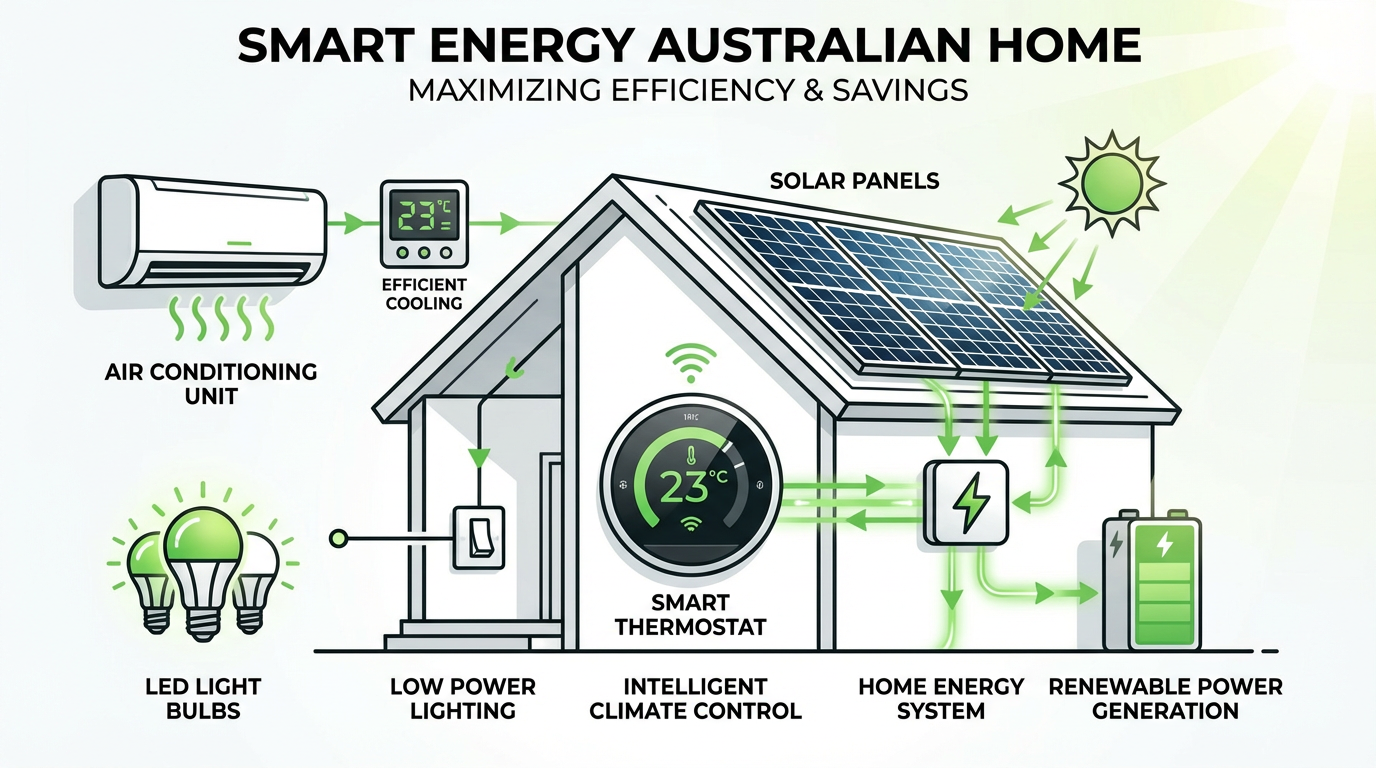
Australian Home Energy Efficiency Guide for 2026
Sydney homeowners are facing unprecedented energy costs this summer. With January 2026 bringing record-breaking heatwaves across NSW and electricity prices surging beyond previous peaks, the question isn’t whether to reduce energy bills—it’s how to do it effectively, starting today.
The Australian Energy Regulator reports that average household electricity bills have increased by 18% in the past year, with summer months seeing the highest consumption and costs. For Sydney, Central Coast, and Newcastle residents, air conditioning alone can account for 40% of total energy usage during peak summer periods. When temperatures soar above 35°C for days on end, running cooling systems becomes non-negotiable—but the financial impact can be devastating.
The good news? Strategic energy efficiency improvements can reduce your summer electricity bills by 20-40% without sacrificing comfort. This comprehensive guide reveals proven methods to lower energy consumption through smart electrical upgrades, plumbing efficiency improvements, roofing solutions, and behavioral changes that deliver immediate savings.
Whether you’re dealing with skyrocketing air conditioning costs, inefficient hot water systems, or poorly insulated spaces that lose cool air instantly, this Sydney-specific energy efficiency guide provides actionable solutions. We’ll cover everything from quick DIY fixes that cost nothing to professional upgrades that pay for themselves within 2-3 years through reduced energy bills.
With NSW government rebates ending for most households in January 2026, taking control of your energy consumption has never been more critical. Let’s explore exactly how to reduce energy bills this summer while maintaining a comfortable, cool home throughout the hottest months.
Understanding Your Sydney Energy Bills in Summer
Before implementing energy-saving strategies, understanding where your money goes is essential. Sydney electricity bills comprise several components, and summer usage patterns differ dramatically from winter consumption.
Energy retailers charge based on kilowatt-hours (kWh) consumed, but pricing structures vary significantly. Most Sydney households are on one of three tariff types: flat rate (same price 24/7), time-of-use (different rates for peak/off-peak/shoulder periods), or controlled load (separate circuit for hot water). Summer peaks occur between 2pm-8pm when air conditioning demand surges across Sydney, pushing grid capacity to its limits and triggering the highest electricity rates.
The average Sydney household consumes 15-20 kWh daily in winter but can spike to 30-40 kWh during summer heatwaves. At current NSW electricity rates averaging 33-38 cents per kWh during peak periods, a single hot week running air conditioning continuously can add $150-200 to your monthly bill. For context, a 5kW split system air conditioner running for 8 hours daily consumes approximately 40 kWh—costing $12-15 per day during peak rate periods.
Major Energy Consumers in Summer
- Air conditioning and cooling (35-45% of summer energy use)
- Hot water systems (15-25% year-round, higher in summer with more showers)
- Refrigeration (8-12%, working harder in heat)
- Pool pumps and equipment (10-15% for pool owners)
- Lighting (5-8%, less with LED conversions)
- Entertainment and computing (8-12%)
- Washing machines and dryers (5-8%)
- Cooking appliances (3-5%)
- Standby power consumption (5-10% across all devices)
Priority Focus: To reduce energy bills effectively in Sydney summers, concentrate on air conditioning efficiency, hot water optimization, and eliminating standby power waste. These three categories alone account for 60-75% of controllable summer energy consumption.
Smart Electrical Upgrades That Reduce Energy Bills
Licensed electrical upgrades deliver the most significant long-term energy savings. While these investments require upfront costs, the combination of reduced electricity consumption and improved comfort creates compelling return-on-investment, typically paying for themselves within 2-4 years.
Complete LED Lighting Conversion
LED lighting represents the easiest, fastest-payback electrical upgrade available. Traditional halogen downlights consume 50 watts each, while equivalent LED downlights use just 7-9 watts—an 82-85% reduction in lighting energy consumption.
For an average Sydney home with 30 downlights operating 5 hours daily, the annual electricity savings exceed $400. LED conversion costs approximately $35-50 per fitting when performed by licensed electricians, meaning the investment recovers within 3-4 years. Beyond energy savings, LEDs produce 90% less heat than halogens—reducing air conditioning load during summer and improving overall comfort.
Modern LED systems offer additional benefits: dimmable options reduce consumption further, smart LED systems enable automated scheduling and remote control, colour temperature selection (warm white 2700K-3000K for living areas, cool white 4000K-5000K for task lighting), and 15,000-50,000 hour lifespans eliminate frequent bulb replacements.
Professional Tip: Licensed electricians can identify transformer compatibility issues with LED installations. Incompatible transformers cause flickering, premature LED failure, and potential fire hazards. Always use qualified professionals for LED conversions.
Smart Thermostat Installation for Air Conditioning Control
Smart thermostats revolutionize air conditioning efficiency by learning usage patterns, adjusting temperatures automatically, and enabling remote control via smartphone apps. For Sydney households, smart thermostat installations reduce cooling costs by 15-30% through optimized operation.
Traditional thermostats maintain constant set temperatures regardless of occupancy or external conditions. Smart systems like Nest, Ecobee, and Sensibo adjust automatically based on home occupancy (using motion sensors and smartphone location), weather forecasts (pre-cooling during off-peak periods), and usage patterns (learning when you typically arrive home). Many models integrate with solar systems, shifting cooling to periods of maximum solar generation.
Installation requires licensed electrician expertise, particularly for systems without C-wire (continuous power wire) connections. Professional installation costs $250-450 including thermostat hardware, but annual savings of $200-400 on cooling costs deliver rapid payback. Smart thermostats also provide detailed energy consumption reports, identifying opportunities for further optimization.
Strategic Ceiling Fan Installation
Ceiling fans don’t actually lower room temperature—they create air movement that makes occupants feel 2-4°C cooler through enhanced evaporative cooling from skin. This perceptual cooling allows air conditioning thermostats to be set 2-3°C higher while maintaining comfort, reducing cooling energy consumption by 20-30%.
A typical ceiling fan consumes just 20-50 watts compared to 2,000-5,000 watts for air conditioning systems. Running ceiling fans continuously costs approximately $15-25 monthly, while achieving equivalent comfort through air conditioning alone costs $150-300 monthly during Sydney summers.
Professional installation by licensed electricians ensures proper mounting (ceiling joists can support fan weight and vibration), correct blade height (optimal efficiency at 2.4-3m ceiling height), and appropriate sizing (fan diameter matching room size: 107-122cm for bedrooms, 132-152cm for living areas). DC motor ceiling fans offer 70% more energy efficiency than traditional AC motor models, consuming as little as 3 watts on low speed.
Modern Switchboard Upgrades for Energy Monitoring
Older switchboards with ceramic fuses lack capacity for modern energy monitoring systems and solar integration. Upgrading to contemporary circuit breaker switchboards with smart metering enables real-time energy consumption tracking, identifying wasteful appliances and usage patterns.
Smart switchboards with integrated energy monitors display live power consumption per circuit, allowing homeowners to identify which areas consume most electricity. This data-driven approach reveals hidden energy waste—such as old second fridges in garages consuming $200+ annually, or faulty appliances drawing excessive power. Licensed electrician switchboard upgrades cost $1,500-3,500 depending on home size and complexity, but the energy visibility they provide enables informed decisions that reduce bills by 10-20% ongoing.
Modern switchboards also provide enhanced safety through individual circuit RCDs (safety switches), surge protection for expensive electronics, and capacity for future solar and battery storage integration. For homes planning solar installations, switchboard upgrades often prove necessary and should be completed concurrently to minimize total installation costs.
Air Conditioning Optimization Strategies
Air conditioning represents the single largest controllable energy expense for Sydney households in summer. Optimizing cooling systems delivers immediate, substantial bill reductions without sacrificing comfort.
Professional Air Conditioning Maintenance
Regular professional maintenance improves air conditioning efficiency by 15-25%. Unmaintained systems accumulate dust on internal components, refrigerant levels drop gradually, and condensate drains block—all reducing cooling capacity while increasing energy consumption.
Annual pre-summer servicing by licensed technicians includes filter cleaning/replacement (improves airflow and efficiency), refrigerant level checking and recharging if necessary, condensate drain clearing (prevents water damage and humidity problems), fan motor lubrication, electrical connection inspection, and thermostat calibration. Service costs typically range $150-250 per system but saves $200-400 annually through improved efficiency and prevents expensive emergency repairs during peak summer when technician availability is limited and callout costs surge.
For ducted systems serving entire homes, professional cleaning of ductwork every 3-5 years removes accumulated dust and mould, improving indoor air quality while restoring airflow efficiency. Blocked ducts force systems to work harder, increasing energy consumption by up to 30%.
Optimal Temperature Settings and Operating Strategies
The Australian Government recommends 24-26°C as the optimal air conditioning temperature—balancing comfort with energy efficiency. Each degree cooler than 24°C increases energy consumption by approximately 10%. Setting systems to 22°C versus 25°C nearly doubles cooling costs without proportional comfort gains.
Effective operating strategies include pre-cooling during off-peak electricity periods (typically before 2pm when rates are lower), using ceiling fans to enable higher thermostat settings, closing doors to unused rooms (reducing cooled space), closing blinds and curtains during peak sun hours (reducing heat gain by up to 45%), and setting thermostats to ‘auto’ fan mode rather than continuous operation (reducing energy use by 15-20%).
For households with time-of-use electricity tariffs, smart scheduling makes dramatic differences. Pre-cooling homes to 22°C during off-peak periods (when electricity costs 15-20 cents per kWh), then allowing temperatures to drift to 26°C during peak periods (when rates reach 35-50 cents per kWh) can reduce total cooling costs by 30-40% while maintaining comfort throughout the day.
Hot Water System Efficiency Improvements
Hot water represents 15-25% of household energy consumption year-round. While often overlooked in summer energy discussions, hot water optimization delivers substantial savings that compound across all seasons.
Heat Pump Hot Water Systems
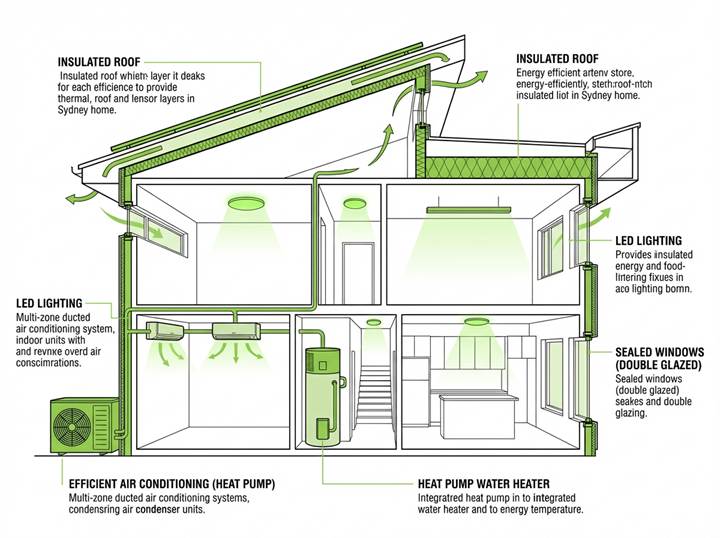
Heat pump systems represent the most energy-efficient hot water technology available, using 60-75% less electricity than traditional electric storage systems. Rather than heating water directly with electric elements, heat pumps extract warmth from ambient air—similar to reverse-cycle air conditioning—making them exceptionally efficient in Sydney’s climate.
For typical Sydney households, replacing old electric hot water systems with heat pumps reduces hot water energy costs from $600-800 annually to $150-250—savings of $450-550 per year. Installation costs range $3,500-5,500 professionally installed by licensed plumbers and electricians, delivering full payback within 6-8 years. Combined with Small-scale Technology Certificates (STCs) rebates of $500-900, effective costs reduce significantly.
Heat pumps work most efficiently in warm climates, making them ideal for Sydney conditions. They operate effectively in temperatures as low as -10°C but achieve maximum efficiency at 15-30°C—precisely Sydney’s average temperatures. Unlike solar hot water requiring north-facing roof space, heat pumps install on ground level or walls, providing flexibility for any property layout.
Solar Hot Water Systems
Solar hot water systems harness free energy from Sydney’s abundant sunshine, reducing hot water energy costs by 50-75% compared to electric systems. Two main types exist: flat plate collectors (more affordable, effective in Sydney climate) and evacuated tube systems (higher efficiency, better for cooler climates or higher hot water demands).
Professional installation by licensed plumbers costs $4,000-7,000 depending on system size and complexity, with government rebates (STCs) reducing costs by $1,000-1,500. Annual savings of $400-600 on hot water energy bills deliver payback periods of 5-8 years. Solar systems require unshaded north-facing roof space (approximately 4-6 square metres) and integrate gas or electric boost elements for periods of insufficient solar gain.
Sydney’s climate provides ideal solar hot water conditions—average 7-8 hours daily sunshine year-round. Even during cloudy periods, modern systems capture diffuse solar radiation, providing 50-70% of hot water needs without boost element activation. Combined with heat pump backup rather than electric elements, hybrid solar-heat pump systems achieve 80-90% renewable energy hot water while ensuring unlimited supply.
Hot Water Temperature Optimization
Hot water systems typically ship from factories set to 70-75°C—far higher than necessary and wasting significant energy. Reducing storage temperatures to 60°C maintains legionella bacteria control (requires 60°C minimum) while reducing standby heat losses and heating energy consumption by 15-20%.
Hot water delivered to taps should be 50°C maximum to prevent scalding, particularly in households with young children or elderly residents. Tempering valves installed by licensed plumbers mix hot and cold water, delivering safe temperatures while allowing storage tanks to maintain 60°C for health safety. This configuration maximizes energy efficiency while ensuring safety and compliance with Australian Standards.
Insulating hot water pipes—particularly first 1-2 metres from storage tanks—reduces heat loss by up to 30%. Pipe insulation foam costs just $20-40 for typical installations and can be installed by homeowners, saving $50-80 annually on wasted energy. For homes with long pipe runs between hot water systems and bathrooms/kitchens, circulation losses can waste 20-30% of heating energy.
Insulation and Building Envelope Improvements
Thermal insulation and air sealing prevent cool air escaping during summer and reduce heat infiltration—the primary causes of excessive air conditioning operation. While requiring upfront investment, proper insulation delivers 20-30 year lifespans with ongoing savings every summer and winter.
Roof and Ceiling Insulation
Roof spaces in uninsulated Sydney homes reach 60-70°C during summer, radiating heat downward into living spaces and forcing air conditioning systems to work continuously. Quality ceiling insulation (minimum R3.5 rating for Sydney climate, R4.0-R5.0 optimal) blocks this heat transfer, reducing cooling loads by 30-45%.
Professional insulation installation costs $15-25 per square metre for bulk insulation (glasswool or polyester batts), meaning typical 150-square-metre homes invest $2,250-3,750. Annual cooling cost reductions of $300-500 deliver payback within 5-8 years, with benefits continuing for decades. Correctly installed insulation also reduces winter heating costs comparably, providing year-round value.
Older Sydney homes often contain inadequate or compressed insulation. Licensed roofing professionals assess existing insulation during inspections, identifying areas requiring upgrade. Adding insulation to already-insulated spaces delivers diminishing returns—upgrading from R2.0 to R3.5 provides greater benefit than R3.5 to R5.0—so professional assessment ensures cost-effective improvements.
Window Treatments and Glazing
Windows represent the weakest thermal barriers in homes, accounting for 25-35% of total heat gain during summer. West-facing windows particularly problematic in Sydney, receiving intense afternoon sun precisely when outdoor temperatures peak and air conditioning operates hardest.
Effective window treatments include external shade structures (awnings, pergolas, deciduous trees providing summer shade but allowing winter sun), cellular or honeycomb blinds (trapped air pockets provide insulation), reflective or blackout curtains/blinds (blocking up to 45% of heat gain), and window films (rejecting 50-70% of solar heat without blocking visible light). Combined strategies deliver best results—external shading blocking heat before it reaches glazing, with internal treatments providing secondary defense.
For homes undertaking renovations, double-glazing retrofits reduce heat transfer through windows by 50-60% compared to single glazing. While expensive ($600-1,200 per square metre installed), double-glazing transforms comfort in homes with large glass areas or poor orientation. Alternatively, secondary glazing systems (installing additional internal glazing panels) costs $200-400 per window and delivers 70-80% of double-glazing benefits.
Air Sealing and Draught Proofing
Air leaks around doors, windows, exhaust fans, and penetrations for pipes and wires allow cool air to escape while hot air infiltrates—forcing air conditioning systems to compensate continuously. Comprehensive air sealing reduces cooling energy consumption by 10-20% at minimal cost.
DIY air sealing focuses on obvious gaps using caulk, expanding foam, weather stripping, and door sweeps. Target areas include gaps around window and door frames, exhaust fan housings in ceilings, downlight fittings (requiring IC-rated covers to prevent fire hazards), electrical outlets and switches on external walls, and penetrations where plumbing and electrical services enter the home.
Professional building envelope assessments using thermal imaging cameras identify hidden air leaks invisible to visual inspection. Licensed assessors provide detailed reports prioritizing sealing locations by impact. For $300-500, comprehensive assessments guide cost-effective sealing programs saving $100-200 annually ongoing.
Zero-Cost Behavioural Changes That Reduce Energy Bills
While equipment upgrades deliver the largest energy savings, strategic behavioural changes reduce bills immediately without any investment. Combining upgraded systems with smart usage habits maximizes results.
Shift Usage to Off-Peak Periods
For time-of-use tariffs, operating washing machines, dishwashers, pool pumps, and electric vehicle charging during off-peak periods (typically 10pm-7am) reduces costs by 50-60% for those appliances. Set timers to automate off-peak operation.
Eliminate Standby Power
Electronics and appliances draw power even when “off”—called standby or vampire power. Entertainment systems, computers, phone chargers, and kitchen appliances collectively waste 5-10% of household energy. Using switched power boards to completely disconnect devices when not in use eliminates this waste, saving $80-150 annually.
Strategic Natural Ventilation
Opening windows during cool evening and early morning hours (when outdoor temperatures drop below indoor temperatures) provides free cooling, reducing air conditioning operation. Cross-ventilation using windows on opposite sides creates airflow that cools homes naturally. Sydney typically experiences 8-12°C temperature drops overnight—utilizing this natural cooling minimizes mechanical cooling needs.
Outdoor Cooking
Using outdoor barbecues instead of indoor ovens during summer prevents adding heat to living spaces that air conditioning must then remove. Each oven-cooked meal adds 2-3 kWh of heat to indoor spaces—requiring 3-4 kWh of air conditioning to remove. Outdoor cooking eliminates this energy waste entirely.
Cold Water Washing
Modern detergents work effectively in cold water, eliminating energy needed to heat washing water. Switching from hot (60°C) to cold water washing reduces laundry energy consumption by 85-90%, saving $150-200 annually for typical households doing 5-6 loads weekly.
NSW Government Rebates and Financial Assistance
While universal energy bill rebates ended for most households in January 2026, targeted rebates and financing programs remain available for energy efficiency upgrades. Understanding eligibility can significantly reduce improvement costs.
Current NSW Energy Programs (2026)
Energy Savings Scheme (ESS): This demand-side management program requires energy retailers to purchase Energy Savings Certificates created by approved activities. Homeowners access ESS benefits through registered certificate providers who discount energy-efficient product installations. Discounts apply to heat pump hot water systems ($500-900), air conditioning upgrades ($200-600), pool pump replacements ($150-300), and insulation installations ($300-800).
Small-scale Technology Certificates (STCs): Federal government incentives for solar hot water and heat pump systems provide point-of-sale discounts through assigned certificates. STC values fluctuate based on system size and location zone (Sydney is Zone 3), with typical rebates of $500-1,500 reducing upfront costs significantly.
Low Income Household Rebate: NSW residents holding eligible concession cards receive $285 (ex-GST) annually as automatic credits on electricity bills. While not specifically for energy efficiency upgrades, this ongoing support helps offset bills while households implement efficiency improvements.
Energy Efficient Communities Program: Managed by the NSW Office of Energy and Climate Change, this program funds community organizations delivering energy efficiency support to low-income households, including assessments, education, and subsidized upgrades.
Professional Services for Energy Efficiency
Achieving maximum energy bill reductions requires expertise across multiple trades—electrical, plumbing, and roofing professionals working together to optimize entire home systems rather than individual components.
Comprehensive Home Energy Audits
Professional energy audits provide data-driven insights into specific energy waste in your home. Licensed assessors use thermal imaging cameras to identify insulation gaps and air leaks, energy monitors to measure appliance consumption, blower door tests to quantify total air leakage, and visual inspections of all energy-consuming systems.
Comprehensive audits cost $300-600 for Sydney homes and include detailed reports prioritizing improvements by payback period and impact. Rather than guessing which upgrades deliver best value, audits provide evidence-based recommendations ensuring investment in most beneficial improvements first. Many audits include ongoing support, helping homeowners interpret energy bills and measure improvement results.
For households uncertain where to begin energy efficiency journeys, professional audits provide the roadmap. Reports typically identify $500-1,500 in annual savings opportunities, with combinations of low-cost and major improvements phased over 2-3 years to spread costs while delivering progressive bill reductions.
Integrated Electrical, Plumbing & Roofing Solutions
Energy efficiency crosses traditional trade boundaries. Optimal results require licensed electricians (LED lighting, smart thermostats, switchboard upgrades, ceiling fans, air conditioning maintenance), licensed plumbers (hot water system upgrades, water efficiency improvements, pipe insulation), and qualified roofing professionals (insulation installation, roof ventilation, reflective coatings, gutter systems for rainwater harvesting).
Engaging trade companies offering comprehensive services like OnTime Tradie—with licensed professionals across all disciplines—streamlines improvement projects. Coordinated assessments identify interdependencies between systems, prevent conflicting recommendations, and enable efficient project scheduling with single-point accountability.
For example, hot water system replacement projects often require both plumbing (system installation) and electrical (power supply modification, potentially switchboard upgrade). Coordinated service eliminates delays from scheduling separate trades and ensures compliant, warrantied installations. Similarly, solar panel installations require roofing assessment (structural capacity, waterproofing), electrical work (inverter, metering, switchboard), and plumbing for solar hot water integration.
Measuring and Tracking Energy Savings
Implementing energy efficiency improvements without tracking results leaves you guessing whether investments delivered promised savings. Systematic measurement validates effectiveness and identifies further optimization opportunities.
Compare electricity bills before and after improvements: Track monthly kWh consumption rather than dollar costs (which fluctuate with pricing changes). Calculate percentage reductions and monthly savings. Typical improvements deliver 15-25% reductions initially, with 30-40% achievable through comprehensive programs.
Use smart meter data: NSW has progressively installed smart meters providing detailed consumption data via retailer online portals. Access daily, hourly, or 30-minute interval data to identify peak usage periods and high-consuming days. Compare consumption patterns before and after improvements to validate impact.
Monitor individual circuits: Smart switchboards and plug-in energy monitors measure consumption of specific circuits or appliances. Identify worst energy offenders and track improvement after upgrades or behaviour changes.
Set reduction targets: Establish measurable goals (e.g., “reduce summer average daily consumption from 35 kWh to 25 kWh”) and track progress monthly. Celebrate successes and investigate when targets aren’t met.
Taking Action on Summer Energy Bills Today
Sydney homeowners face a clear choice this summer: accept skyrocketing energy bills as inevitable, or implement proven strategies that reduce consumption while maintaining comfort. The comprehensive approaches outlined in this guide deliver measurable results—typically reducing summer electricity costs by 20-40% through combinations of equipment upgrades, building envelope improvements, and behavioural changes.
Starting your energy efficiency journey doesn’t require completing everything simultaneously. Prioritize high-impact, quick-payback improvements first—LED lighting conversion, air conditioning maintenance, hot water temperature adjustment, and eliminating standby power consumption deliver immediate savings with minimal investment. Then progress to major upgrades—heat pump systems, ceiling insulation, smart thermostats—that provide decades of ongoing value.
With January 2026 marking the end of universal energy bill rebates, reducing energy consumption transforms from optional to essential for budget-conscious households. The most effective time to implement energy efficiency improvements is before peak summer heat arrives. Waiting until mid-summer when systems fail or bills shock means competing for limited tradie availability, paying emergency pricing, and enduring discomfort during installation delays.
Professional energy audits provide data-driven roadmaps customized to your specific home, prioritizing improvements by impact and payback. Licensed tradespeople ensure compliant, safe installations that deliver promised savings through proper implementation. While DIY approaches suit some improvements, electrical, plumbing, and significant roofing work requires qualified professionals—both for performance and insurance validity.
The compounding benefits of energy efficiency extend beyond immediate bill savings. Reduced energy consumption decreases carbon footprint, supports Australia’s renewable energy transition, and improves home comfort year-round. Energy-efficient homes command higher resale values, attract buyers faster, and increasingly satisfy buyer expectations for modern, sustainable properties.
Take control of your energy costs today. Schedule professional assessments, implement no-cost behavioural changes immediately, and plan equipment upgrades strategically. Sydney’s summer heat isn’t going away, but your massive energy bills can.
Ready to reduce your summer energy bills?
OnTime Tradie provides comprehensive energy efficiency solutions across Sydney, Central Coast, and Newcastle. Our licensed electricians, plumbers, and roofing specialists deliver integrated assessments and installations with transparent pricing and lifetime workmanship warranties. Contact us today at 0488 822 795 for your energy efficiency consultation.
Don’t wait for the next heatwave. Reduce your energy bills starting now.
